Services & Products
Integrated Energy Solutions Business Unit
Pursuing a stable supply of energy through a value chain business spanning upstream to downstream.
Advancing a unique, multifaceted, and flexible approach to develop and deliver industrial solutions for global climate change, bringing together the knowledge, business foundations, and customer and partner base of Mitsui & Co.’s diverse business fields
Business fields
- Exploration, development and production of oil, natural gas and other energy resources
- Trading and marketing of oil, petroleum products, coal, uranium and other energy resources
- Next-generation energy (hydrogen, ammonia, biofuels, SAF, carbon solutions such as carbon credits and CO2 utilization)
- New business that anticipates structural changes, joint initiatives with other Business Units, businesses that consider the global environment (development of low-carbon cities, decarbonization support, and exploration of new technologies and innovations, etc.)
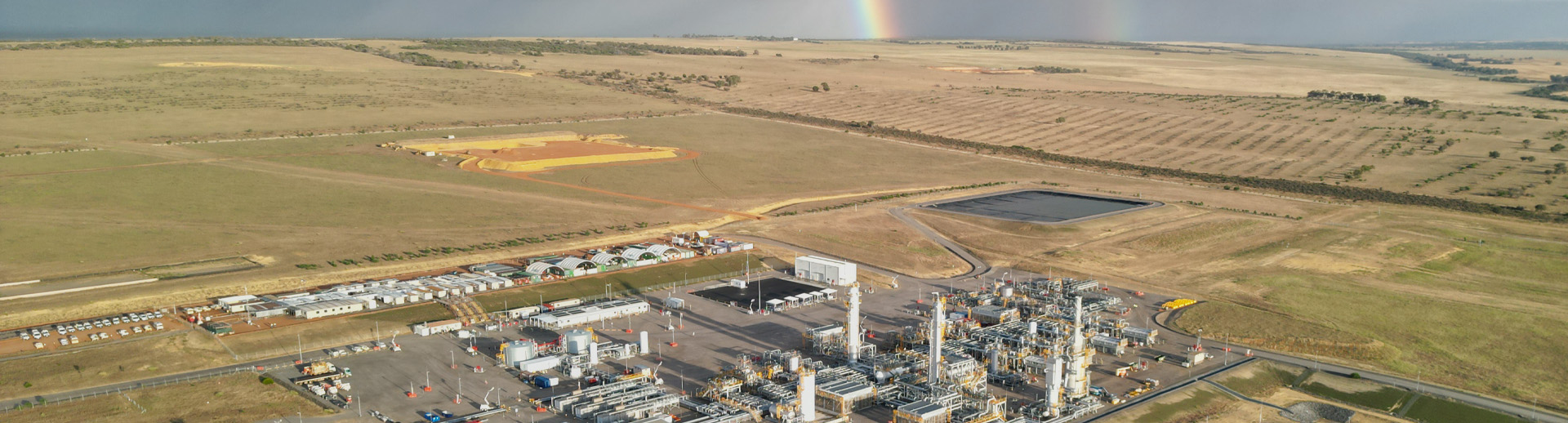
Aiming for zero-emission generation from coal-fired power stations (02:10)
Successfully completed test operation of oxyfuel combustion technology on Callide-A, currently working on commercialization
Major activities
Building a balanced energy resource portfolio and developing a value chain business
Major changes are currently taking place in global energy markets. Europe, the United States and other developed nations across the world have liberalized their energy markets, new businesses are emerging through technological innovation, and companies are strengthening their ESG (Environmental, Social and Governance) strategies. In this evolving environment, Mitsui’s Integrated Energy Solutions Business Unit is focused on establishing a stable supply system to meet growing energy demand, while maintaining a well-balanced energy resource portfolio that addresses the diverse needs of society and customers and further developing its energy value chain business spanning upstream to downstream.
Mitsui's core oil and natural gas assets for exploration, development and production are based in the Middle East, Southeast Asia, Oceania, North America, and Europe, and we maintain a portfolio that is balanced in terms of geography, products, development phases and partners. In the U.S. we utilize Mitsui's comprehensive strengths to build a value chain that leverages our upstream business in such areas as chemicals, liquefaction facilities and other plants, and steel products for drilling and ships. Utilizing our knowledge and expertise accumulated in the upstream business, we are also pursuing a range of new initiatives including equity participation in a company engaged in Carbon dioxide Capture and Storage (CCS)/Carbon dioxide Capture, Utilization and Storage (CCUS) projects, and the development of geothermal projects.
To strengthen our downstream oil activities in Asia, where demand is expected to grow, we have moved our base of operations from Japan to Singapore, and conduct our global crude oil and petroleum product trading and marketing primarily through Mitsui & Co. Energy Trading Singapore Pte. Ltd. In coal distribution, we import and sell to domestic customers. In addition, we are working to establish a stable biomass fuel supply system for Japanese consumers, which are increasing in demand in line with trends in climate change initiatives. We are also participating in a woody biomass power generation business in Tomakomai, Hokkaido. Furthermore, we contribute to stable nuclear power generation through our nuclear fuel cycle business. In response to the demand for energy transition and decarbonization, we are also engaged in biofuels and carbon credit emissions trading. Our goal is to contribute to a stable supply of energy, and we will constantly endeavor to enhance our trading activities to meet diverse customer needs.
Providing solutions for next-generation energy
In pursuit of carbon neutrality, we provide a range of solutions for the production and commercialization of low-carbon energy through our work, such as the development and production of biofuels and other renewable energy fuels, the development and commercialization of hydrogen, ammonia and other next-generation energy, the creation of emission credits through CO2 abatement, and the development of CO2 utilization and storage technologies. We also contribute to the realization of a circular economy by producing biogas from waste. Examples of our next-generation fuel initiatives include our investment in LanzaJet, a company that produces sustainable aviation fuels (SAF) using Alcohol-to-Jet technology, and our investment in a renewable diesel (hydrotreated vegetable oil/HVO) and SAF production business operated by Galp, Portugal’s biggest energy company. We also invest in Terreva Renewables, a US renewable natural gas production and sales company. We are currently promoting next-generation fuel production on a global scale using these technologies, with the goal of contributing to further lowering the carbon footprint of fuels.
In hydrogen, we have participated in a renewable hydrogen project and low-carbon ammonia projects, and are working on multiple initiatives aimed at establishing a hydrogen and ammonia supply chain. This includes a joint study for the development of bases for receiving, storing, and supplying ammonia in Japan. Our goal through this work is to contribute to the realization of a “hydrogen society,” in which hydrogen is widely used in everyday life and in industrial activities.
Key projects
- Greater Enfield oil field development and production projects (Australia)
- Gulf of Thailand oil and natural gas field development and production project (Thailand)
- Oman oil and natural gas development and production project (Oman)
- Marcellus shale gas development and production project (U.S.A.)
- Eagle Ford shale oil and gas development and production project (U.S.A.)
- Tempa Rossa oil field development and production project (Italy)
- Downstream oil trading and marketing in Asian markets through Mitsui & Co. Energy Trading Singapore Pte. Ltd. (Singapore)
- Clean ammonia and hydrogen production, hydrogen fuel station business (U.S.A., UAE, Australia, New Zealand)
- Biofuel and Sustainable Aviation Fuel (SAF) production business (U.S.A., Portugal, China)
- Carbon credits (Australia, Cambodia, Japan)
- Cloud-based service platform to reduce Co2 emissions, City DX using AI and analyses of personal activity and platform for co-creation efforts toward decarbonization (Japan)
- Investment in innovative technologies and start-ups focused on decarbonization (Japan, U.S.A., Canada)
Trading Up: Building an energy marketing business from scratch
Releases & Topics
- Aug. 20, 2026Releases
- Expansion of Customer Base and Applications for World's First e-methanol Produced in Denmark
- Mar. 30, 2026TSE
- Update on Previous Disclosure:Sale of Interests in Onshore Oil and Gas Assets in the Sultanate of Oman
- Mar. 27, 2026TOPICS
- Ammonia Supply Hub Project Based in the Tomakomai Area of Hokkaido Acquires Certification under Japan's Hub Development Support Program
- Oct. 22, 2025TOPICS
- Participation in the CCS Project at the Arthit Gas Field in Thailand
- Apr. 16, 2025TOPICS
- Investment in US Synthetic Fuel Manufacturer Infinium