Social Impact Assessments and Progress Reports
Initiative to Realize Development of Future Forests That Nurture Abundant Natural Capital in Japan
As of August 31th, 2026
| Grant amount |
¥100,000,000 |
|---|---|
| Recipient |
Green Foresters Inc ("Green Foresters," Chiyoda-ku, Tokyo) |
| Issue finder |
CEO Shotaro Nakai |
| Social issue targeted |
Mitigation of high environmental loads in the construction industry through the reduction of construction material leftover and CO2 emissions |
| Press release |
Social issue: Restoring degraded forests (natural capital) and developing the people who will lead these efforts
Japan has around 10 million hectares of planted forests, but there is a shortage of forestry workers as shown by a 60% decline in the workforce over the past 20 years. As a consequence, while trees covering an area of around 90,000 hectares (about 20,000 times bigger than Tokyo Dome) are harvested each year, replanting covers only 37% of this area, resulting in forest degradation. In addition, there are many forests where logging is not even carried out. Moreover, the value of forests is not limited to timber production. They also provide a wide range of value and benefits to ecosystems, including CO2 absorption, the conservation of biodiversity and water resources, and the prevention of landslides. Forests are a vital form of natural capital for daily life and economic activities, and the maintenance of their functions is a vital social priority.
Green Foresters does not only harvest trees. Instead, it is entrusted with the management of tree-harvested areas by forest owners or it purchases such areas itself and works with corporate sponsors to replant and nurture those areas. Activities in recent years include the planting of forests on former ski resorts and the organization is also working to develop wetlands. In addition, it trains the specialist personnel needed to restore and foster forests and other types of natural capital. It aims to expand the role of forestry workers from timber producers to natural capital enhancement professionals, and to establish a forestry natural capital industry, with income derived from activities that contribute to the conservation and recovery of natural capital. Through these initiatives, Green Foresters strives to increase forestry workers' incomes while pursuing the realization of a society that maintains and enhances the ecosystem services provided by natural capital.
Through the Fund, Mitsui will provide peripheral support for Green Foresters' efforts to consolidate forests. It will also help Green Foresters to deal with governmental requirements, build collaborative relationships with local companies, and find corporate partners that support their forest development vision. As a corporate forest owner, Mitsui shares Green Foresters' philosophy and will continue to contribute to the transformation of the Japanese forestry industry and the enhancement of natural capital in Japan.
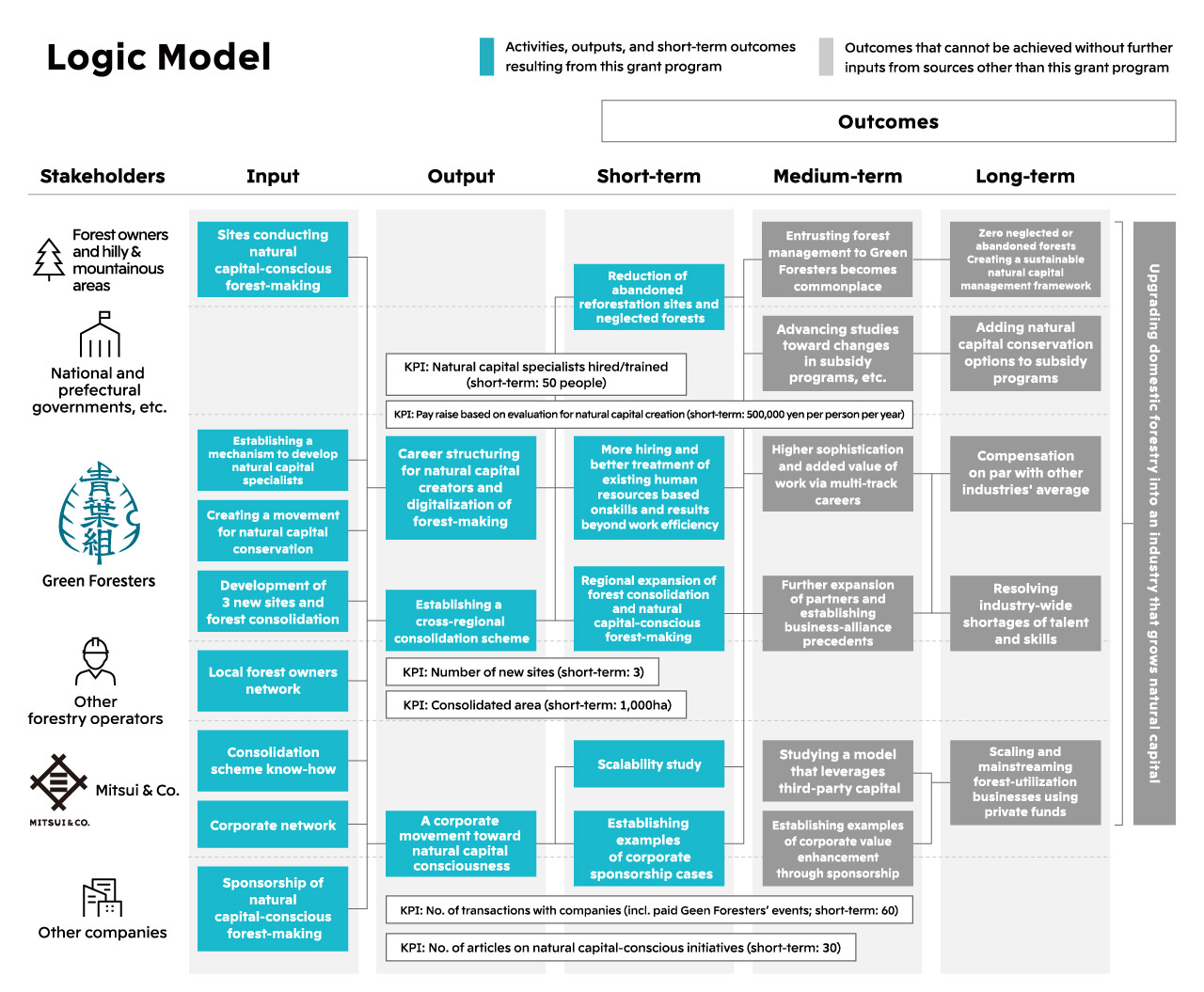
Social Impact Assessments (Logic Model and KPIs)
Dialogue between issue finder and co-creator

Interviewer: Daisuke Watanabe (Mitsui & Co., right)
Interviewee: Shotaro Nakai (Green Foresters, left)
Watanabe: Mr. Nakai, could you first tell us what led you to start Green Foresters?
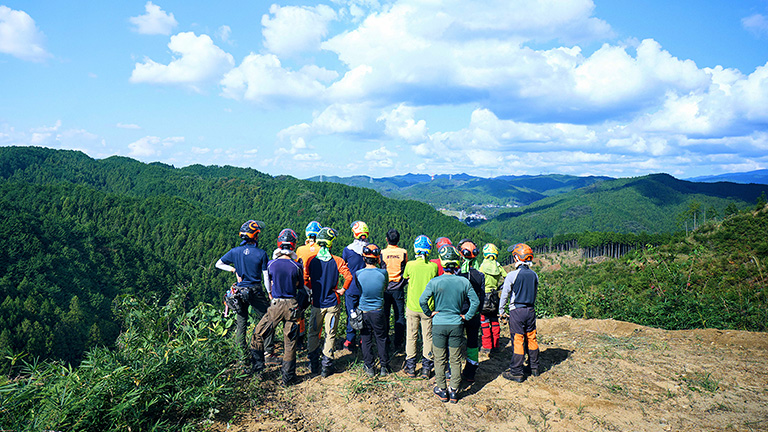
Nakai: Japan has approximately 10 million hectares of planted forests, but the number of forestry workers engaged in planting and tending trees has fallen by 60% over the past 20 years. As a result, when trees are cut down, there are not enough people to plant new ones. The reforestation rate remains only around 50%, and about 40,000 hectares of logged land are left unattended each year. Grasslands have decreased by 90% over 100 years, and wetlands have decreased by 60% over 150 years. Seeing this reality firsthand, I started the company in 2020 because I wanted to make it a viable business not only to restore the cycle of cut, use, and plant, but also to restore the value of the many forms of natural capital that forests provide, such as CO2 absorption, biodiversity, and water source conservation.
Watanabe: I myself have been involved in the wood and building materials business at Mitsui & Co., and I have heard many times from the forestry frontlines in Japan that there are not enough people to plant trees. I remember strongly relating to your passion in directly taking on this issue.
Watanabe: How did you learn about the Mitsui & Co. Co-creation Fund?
Nakai: We had been exchanging views with Mitsui & Co. employees since around 2023 on reforestation and J-Credits, and we learned about the fund through those discussions. We found out that social startups were also eligible, and with recommendations from co-creators including you, Mr. Watanabe, we officially applied for grants in November 2024. The discussions themselves had started much earlier, and we spent about one year refining the application content.
Watanabe: At first, we had contact with Green Foresters in a different business context, but as we continued our dialogue, we came to deeply support your concept of growing natural capital. As the cedar and cypress trees planted during the postwar period of expanded afforestation reach the logging stage, there is now a clear need to keep the cycle of cut, use, and plant working in a healthy way. I was convinced that you were someone who could take on this challenge directly with passion, which led us to recommend you to the fund.
Watanabe: What was your impression after actually using the fund?
Nakai: To be honest, the financial support is extremely helpful. For a small venture like us, being able to secure stable funds to purchase logged land, open new sites, and hire and develop people is vital for our business. But what we value even more is that Mitsui & Co. employees actually work alongside us as co-creators. This is not simply a donation. Co-creators visit the sites with us, support negotiations with local governments and forest owner cooperatives, and help us find sponsor companies. This hands-on support is worth more than the funding itself.
Watanabe: We are also learning a great deal through co-creation with you. This is our first experience of working deeply on the planting side of the frontlines, and it has helped us understand the issues in forestry from multiple angles.
Watanabe: Could you tell us what you expect from co-creators and what value is being created through this collaboration?
Nakai: We have received help mainly in two areas. The first is the use of the corporate network. To make natural capital restoration viable as a business, it is essential for us to find sponsor companies. Through Mitsui & Co.'s network, we have been able to make a proposal on planting collaboration and receive support in considering potential sponsors for natural disaster-damaged forest restoration. Such opportunities gave us access to networks we could not have reached on our own. The second is support for establishing business mechanisms. Mitsui & Co. employees have extensive practical business experience, and their knowledge in areas such as forest consolidation schemes, contract document reviews, and financial model development is very reassuring.
Watanabe: We are also supporting you by using resources across the company, including those of the Corporate Sustainability Division and collaboration with company-owned forests through Mitsui Bussan Forest. Because the fund mechanism exists, I feel that it has become easier to create a cross-divisional cooperation framework.
Watanabe: What is needed beyond the fund to achieve the natural capital restoration that you are aiming for?
Nakai: The most important thing is a change in society's overall mindset. Until now, forestry has been assessed based on the single value of timber, but forests have value as many forms of natural capital, including CO2 absorption, biodiversity conservation, water source conservation, and prevention of sediment-related disasters such as landslips. We are working with the town authorities, academia, and industry in a company-owned forest in Motegi-machi, Tochigi Prefecture, to quantitatively show natural capital recovery through data, including the confirmation of the presence of endangered species such as hotoke-dojo (Japanese eight-barbel loach) and mukashi-tsuchigaeru (wrinkled frog) only five hours after wetland creation. Through this kind of visible evidence of recovery, we believe we can create an environment in which companies can invest in natural capital as a management decision. It is the key to changing forestry from a single-benefit timber-based industry into a multi-benefit industry.
Watanabe: Quantifying and commercializing natural capital is an area that our Corporate Sustainability Division recognizes as an important issue. I feel that Green Foresters' work with various partners in the natural capital field to quantify water source conservation volume and biodiversity is truly on the frontier.
Watanabe: What do you expect from the fund and its ecosystem going forward?
Nakai: By 2034, we aim to create a world in which 16 billion yen in new public and private funding is invested each year in the recovery and growth of natural capital. To achieve this, we need to build up successful examples one by one and prove that investment in natural capital also makes sense economically. We would be very pleased if our work through the fund could become a model case and serve as a guide for other companies and entrepreneurs. In the UK and Australia, markets for nature restoration on the scale of several tens of billions of yen per year are already emerging. We hope to create a social movement so that similar action will accelerate in Japan.
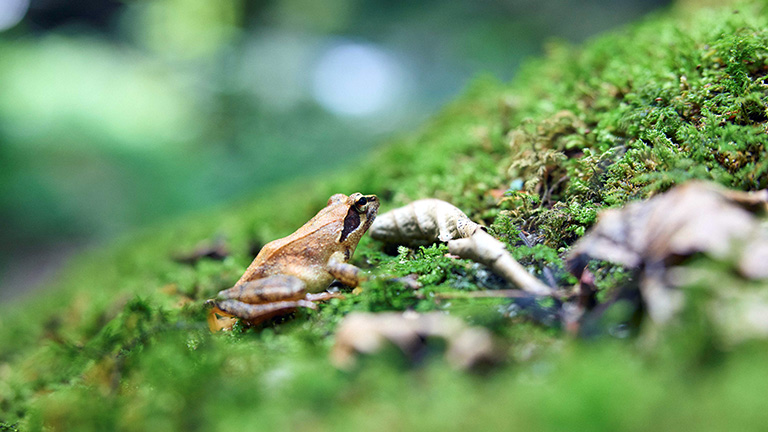
Watanabe: When I visited Green Foresters' company-owned forest the other day, I saw a reforested area where Quercus serrata seedlings had begun to take root, as well as a newly created stream and wetland where frogs had already come to lay eggs, and I was moved by the power of nature to recover. Mitsui has long been deeply involved in forest development in Hokkaido, and I feel very honored that, together with you, we can create a new industry in the Reiwa era: New forestry that fosters natural capital. We will continue to work alongside you as co-creators. Mr. Nakai, thank you very much for your time today.
Activity Highlights

1. Establishing a mechanism to develop natural capital specialists: 16 people are undergoing training against a target of 50 people.
A program to develop natural capital specialists who will lead future forest creation has been launched, with participants gaining practical experience through fieldwork. As of June 2026, the program is supporting the development of 16 people. To generate broader impact across the industry, we plan to expand the program to external participants by around its third year.

2. Amount of pay increase based on evaluation for natural capital creation: Initiatives are under way toward reaching a target of 500,000 yen per person per year.
Pay increases remain at 0 yen because companies do not as yet attach sufficient importance to this evaluation, but increases are expected as corporate transactions grow in the future.

3. Establishing a cross-regional forest consolidation scheme, including a number of new sites and consolidated areas: One site has been opened in Ofunato City against a target of three sites, and 419 hectares have been acquired.
One site has been opened in Ofunato City, Iwate Prefecture, and operations started at the local office. A total of 419 hectares of forest has been acquired as of June 2026, and consolidation will continue toward achieving the 1,000-hectare target. For the other two sites, we are in the process of identifying candidate locations and holding discussions with landowners and other relevant parties.

4. Creating a movement for natural capital conservation: A total of 29 companies have participated against a target of 60 corporate transactions, including paid events held by Green Foresters, and 14 case articles on initiatives that consider natural capital have been published against a target of 30 articles.
Field tours for companies were held three times in Motegi-machi, Tochigi Prefecture, in February, March, and June 2026, and a total of 29 companies participated in the tours and other events. A planting and table tennis event was held with a sponsor company that produces table tennis goods. As of June 2026, 14 articles have been published on Note and other media platforms.
Mitsui’s Materiality
“Build brighter futures, everywhere” as our corporate mission, and to gain the trust and expectations of our stakeholders to realize a better tomorrow for earth and for people around the world, we have identified six material issues (“Materiality”) for Mitsui’s sustainable growth. We anticipate this particular project/ business to contribute especially to the realization of “Foster a well-being society” and “Empower our people to build brighter futures”
-

Establish a foundation for sustainable and stable supply
-

Create a community coexisting with nature
-

Foster a well-being society
-

Cultivate societies that respect human rights
-

Empower our people to build brighter futures
-

Build an organization with integrity