Human Resources Strategy
Medium-term Management Plan and Human Resources Strategy
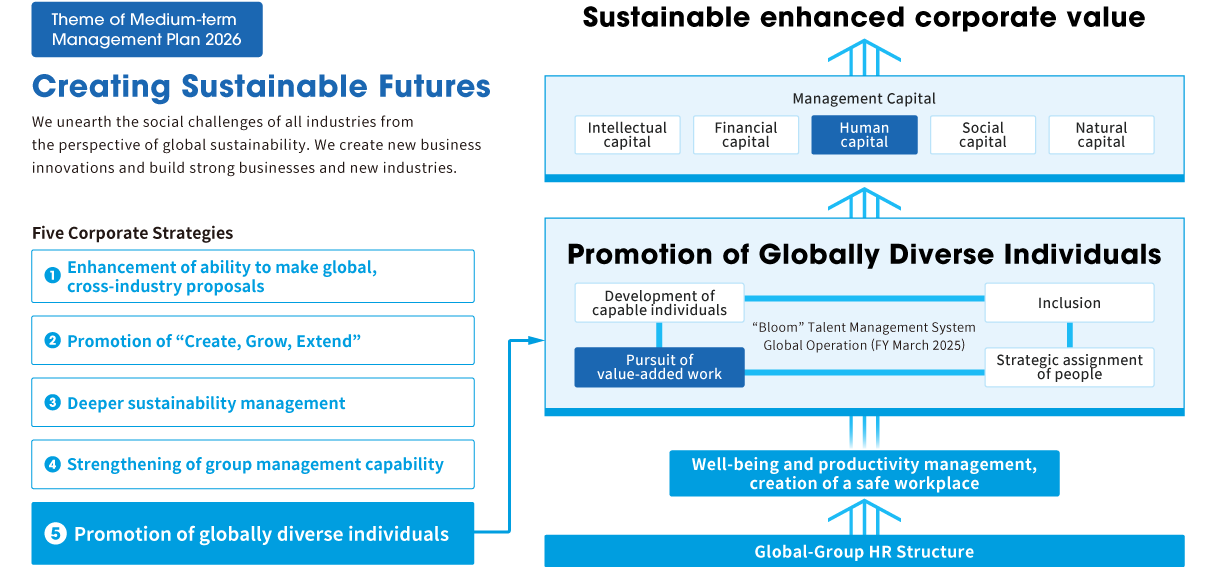
In May 2026, Mitsui announced Medium-term Management Plan 2029 under the theme, “Pathway to 2030 and beyond, Shaping Futures through Trust and Innovation.” We identified continuous strengthening of our human resources strategy and well-being/H&S from a long-term perspective as key themes in achieving ongoing reinforcement of our management foundation.
We regard human capital as an important form of management capital that generates sustainable value, and as a key driving force for the continuous transformation of the business portfolios that generate Mitsui & Co. Group’s competitiveness. To maximize our human capital, we aim to realize our vision for 2030 by advancing the three pillars of our human resources strategy, “Cultivating capable individuals, ” “Inclusion,” and “Strategic allocation of talent,” along with the pillar of a workplace environment in which all colleagues can work with peace of mind.
Employee Engagement
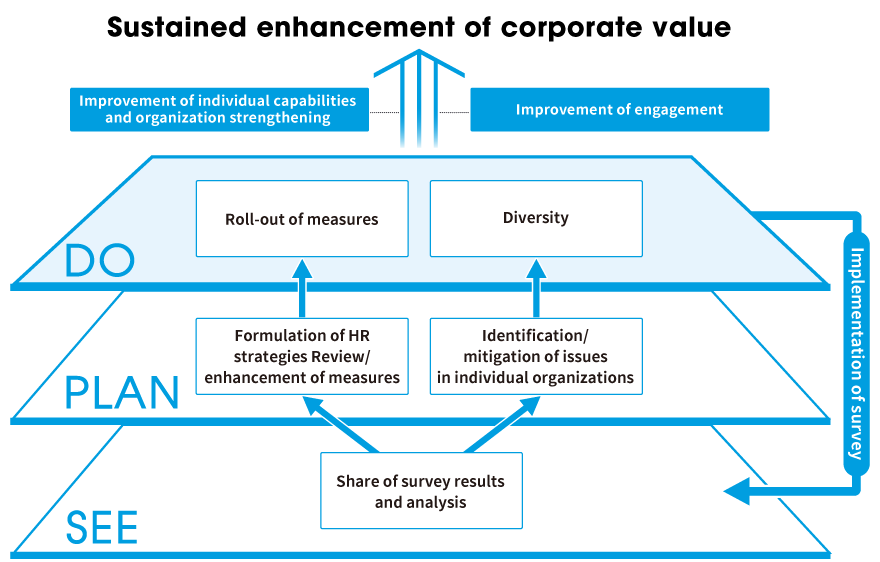
In implementing our management and human resources strategies at Mitsui, we believe it is truly important to maintain a cycle in which each employee understands the thinking behind those strategies in the context of their day-to-day tasks and works toward the sustainable enhancement of corporate value. To facilitate this cycle, we conduct the Mitsui Engagement Survey (MES), which covers Mitsui & Co. Group, every year (it is voluntary for affiliated companies). We have positioned employee engagement as one of the important management indicators to evaluate the effectiveness of our HR strategy, and we use this survey as a tool to perform fixed-point observations of employee engagement and to identify and address issues in organizations.
To ensure the objectivity and transparency of this annual survey, it is outsourced to an external organization to which employees provide their responses directly . MES results, which are reflected in analyses and action plans for each region and organization, are used for formulating frontline organizational development measures driven primarily by the employees themselves. Further, since the formulation and execution of human resources strategies and the review of related measures, through the analysis and discussion of survey results in the Executive Committee, are important responsibilities of management team members, changes in the percentages of positive response rate for “Employee engagement “ and “Employees enablement” are one of the factors used to determine remuneration for directors (excluding external directors). Mitsui & Co. Group will continue to link MES results to initiatives to raise employee engagement and thereby aim to achieve sustainable improvement in corporate value.