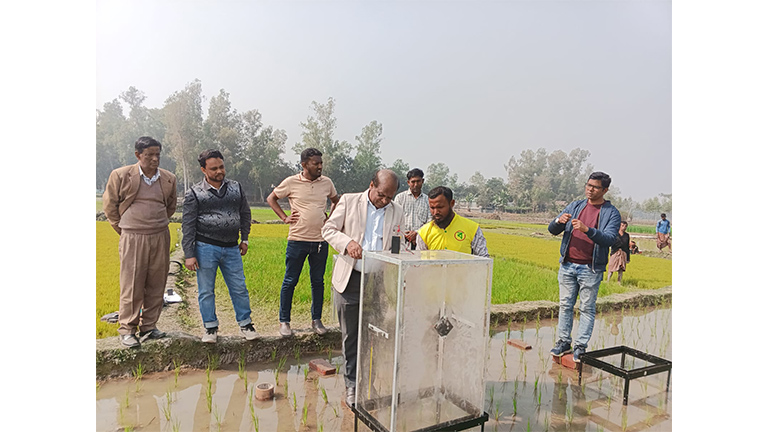
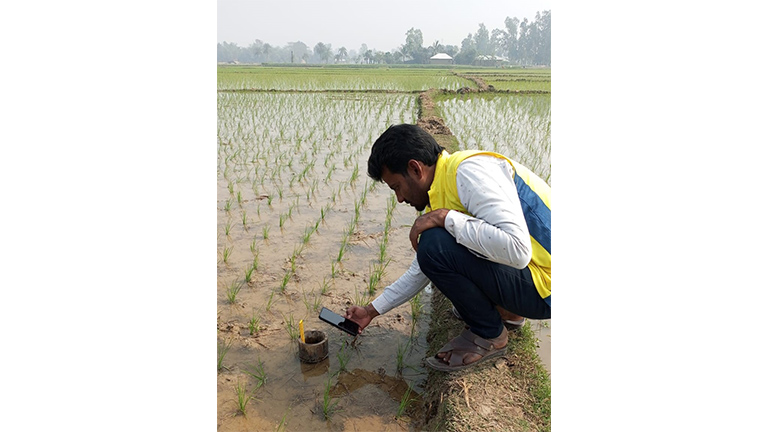
Mitsui & Co., Ltd. ("Mitsui", Head Office: Tokyo, President and CEO: Kenichi Hori) has launched a project to reduce methane emissions through the use of alternate wetting and drying ("AWD"), a water-efficient rice-growing technology, in partnership with Bangladesh Bondhu Foundation ("Bondhu"), an NGO with an extensive track record of initiatives with local farmers in Bangladesh. Mitsui aims to use the Joint Crediting Mechanism* (JCM) for this project.
AWD is a water management method for paddy rice cultivation. Multiple times during the growing period, the fields are drained and allowed to dry thoroughly before being flooded again. Paddy field soil contains methane producers. Under anaerobic conditions (environments in which oxygen is absent or extremely scarce), these organisms consume materials like rice straw and release methane, a potent greenhouse gas. With the AWD method, large amounts of oxygen are supplied to the soil, thereby impeding methanogenic activity in the soil and reducing the amount of methane produced. This approach can be expected to reduce methane emissions by around 30% compared with the usual continuous flooding method.
AWD also reduces the amount of water used. While Bangladesh is the world's third-biggest producer of rice, it relies heavily on groundwater for irrigation, especially in the dry season. The introduction of AWD will result in the spread of sustainable rice cultivation. In addition, many research reports indicate that AWD increases rice yields.
Mitsui plans to use the JCM for this project. Through the JCM, Japan works with other countries to reduce greenhouse gas emissions and shares the benefits of these initiatives with its partner countries. Demand for JCM credits is expected to surge following confirmation of their eligibility under the Green Transformation Emissions Trading System (GX-ETS), which will be fully launched in April of 2026 as Japan's version of the emissions trading scheme.
Through this project, Mitsui aims to promote sustainable rice growing in Bangladesh, while also using the JCM to contribute to the achievement of GHG reduction targets in both Bangladesh and Japan.
*The Joint Crediting Mechanism is a system under which Japan and partner countries share JCM credits based on the quantified reduction or removal of greenhouse gases through joint initiatives. The Japanese government has set targets calling for the reduction or removal of a cumulative total of around 100 million t-CO2 by FY2030 and 200 million t-CO2 by FY2040 through the use of JCM credits.
Company Profile
| Official name | Bangladesh Bondhu Foundation |
|---|---|
| Head Office Location | Dhaka, Bangladesh |
| Established | February 2015 |
| Representative | Dr. Engr. Md. Khalequzzaman (Founder & Program Manager) |
| Number of employees | 1,688 |
| Business Activities | Support for the introduction of environmentally-friendly infrastructure and farming methods in local communities in Bangladesh Extensive experience in the field of AWD |
| Website |
Mitsui’s Materiality
“Build brighter futures, everywhere” as our corporate mission, and to gain the trust and expectations of our stakeholders to realize a better tomorrow for earth and for people around the world, we have identified six material issues (“Materiality”) for Mitsui’s sustainable growth. We anticipate this particular project/ business to contribute especially to the realization of “Create a community coexisting with nature”
-

Establish a foundation for sustainable and stable supply
-

Create a community coexisting with nature
-

Foster a well-being society
-

Cultivate societies that respect human rights
-

Empower our people to build brighter futures
-

Build an organization with integrity