CSO Message
Aiming to create medium- to long-term value through an integrated approach
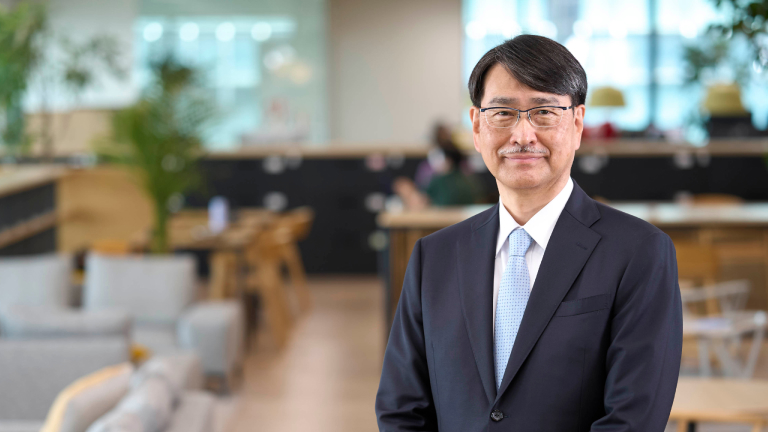
Representative Director,
Executive Vice President
Chief Strategy Officer
Kazumasa Nakai
In light of changes in the business environment, how are you incorporating sustainability into management strategy and linking it to value creation?
Sustainability is a foundation supporting our management. In the previous MTMP, we set out our vision of Creating Sustainable Futures and identified three key management themes of climate change, natural capital, and business and human rights, under which we have steadily advanced specific initiatives.
Amid ongoing changes in the business environment, our stance on sustainability remains unchanged. For MTMP2029, which began in April, we conducted multifaceted scenario analyses that incorporate not only climate change but also the perspective of natural capital, taking into account the relationship among various themes. Based on the outcomes of these analyses, we are pursuing an integrated approach whereby the results are reflected in our management strategy and individual business activities from the perspective of both risk and business opportunity.
Sustainability initiatives are not costs required to conduct business; rather, they help maintain and ideally enhance future competitiveness as well as create growth opportunities. By ensuring that each employee remains mindful of this and thoroughly implements an integrated approach in their respective areas of business, we will enhance environmental, social, and economic value in a balanced manner, further deepen sustainability management, and achieve sustainable growth.
From FY March 2027, disclosure of climate-related information based on SSBJ standards will become mandatory for securities reports issued in Japan. By further advancing our specific sustainability initiatives and expanding the scope and depth of disclosures more than ever before, we aim to gain the trust of stakeholders and enhance our corporate value.
In addition, in MTMP2029, we have further evolved our three Key Strategic Initiatives, one of which is Global Energy Transformation. To address emerging societal challenges such as the rapid increase in electricity demand driven by AI, we have newly established the Digital & Infrastructure Solutions Business Unit, which provides real solutions from clean power supply to the downstream part of the AI value chain, and the Integrated Energy Solutions Business Unit, which enables optimal energy supply including next-generation fuels such as blue ammonia. By combining our diverse capabilities, we will treat sustainability initiatives as opportunities and create new value.
How are you advancing both sustainability and portfolio strengthening?
By ensuring that the Portfolio Management Committee, which serves as an advisory body to the Executive Committee, and the Sustainability Committee, which operates under the Executive Committee, function effectively in a complementary manner, management makes decisions that balance sustainability and growth.
Within the Portfolio Management Committee, portfolio management has been advanced across multiple axes: time, business, and region. From a time-axis perspective, while large-scale projects scheduled to generate earnings beyond 2030 are progressing, we are also focusing on projects that can contribute to earnings in the near-term. From a business-axis perspective, clearly defining the three Key Strategic Initiatives has enabled the formation of a well-balanced project pipeline. Under our global matrix structure—linking business units and regional headquarters, which is one of our core strengths—we are seeing a wide range of opportunities emerging across a broad range of geographies.
For existing projects, base profit has steadily improved through enhancements in asset quality driven by our evolved middle game initiatives, along with enhanced annual asset reviews and disciplined portfolio reconfiguration. By adding carefully selected new projects from an abundant pipeline, we are continuously enhancing the quality of our portfolio.
Meanwhile, the Sustainability Committee deliberates on company-wide policies and measures related to environmental and social risks, including climate change as well as business and human rights. The outcomes are regularly reported to the Executive Committee and the Board of Directors, thereby establishing a robust framework for sustainability management through appropriate oversight. This plays a critical role in project screening and portfolio discussions.