CFO Message
Maintaining a solid financial foundation while executing flexible capital allocation to enhance ROE
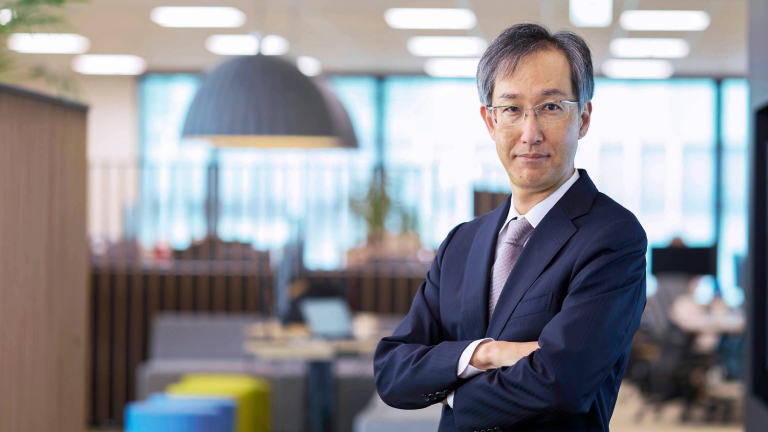
Representative Director
Executive Managing Officer
Chief Financial Officer
Makoto Tanaka
Upon assuming the role of CFO, what principles and perspectives do you consider particularly important?
Since joining Mitsui, I have been engaged in finance-related roles for many years. Finance work at Mitsui includes not only large-scale transactions but also work such as foreign exchange and interest rate dealings that require constant engagement with markets around the clock, which is extremely demanding. Through these experiences, I strongly feel that I have been supported by many people in order to carry out my work, and that understanding and respecting each other’s background and circumstances leads to the sustainable growth of an organization.
It is precisely because of this that I am committed to supporting Mitsui’s spirit of Challenge and Innovation. While respecting the positions and perspectives of everyone we engage with, both inside and outside Mitsui, I aim to further cultivate a corporate culture of open-mindedness where individuals can speak candidly based on their experience and strengths and engage in constructive dialogue.
As of the end of FY March 2026, our total assets reached approximately 20 trillion yen, and interest-bearing debt stood at approximately 5 trillion yen—both at historical highs. As CFO, while building on our longstanding risk management approach, I will further strengthen our consolidated management foundation and internal controls that underpin financial soundness. At the same time, I will support appropriate risk-taking in pursuit of enhancing corporate value.
How would you summarize MTMP2026, and what strategy are you pursuing in MTMP2029?
Over the three years of MTMP2026, despite an operating environment characterized by persistently high uncertainty and volatility, we generated COCF at the 1-trillion-yen level for five consecutive fiscal years, once again demonstrating our strong cash-generating capability.
In addition, strengthening existing businesses, turnaround initiatives, and earnings contributions from investments for growth steadily enhanced our base profit. For FY March 2027, we plan to increase the full-year dividend by 25 yen per share, the largest dividend increase in our history. We also executed large-scale investments that are expected to become significant earnings pillars from 2030 onward. As such, I believe it was a highly productive three years.
At the same time, challenges have become clearer, including disparities in profitability and capital efficiency among businesses, as well as the presence of loss-making and low-profit businesses, and we believe investment discipline must be strengthened further.
In MTMP2029, we see the execution of capital allocation that aligns with changes in the operating environment and enhanced portfolio management as particularly important. We have positioned ROE at the center of our KPIs and, in addition to profit and COCF, will place greater emphasis on ROIC.
What was the intent of management in setting the ROE target of 12% for MTMP2029?
The 12% ROE target reflects a clear commitment by management to continue generating returns that exceed the expectations of capital markets. We are aiming for even higher ROE levels from 2030 onward as large-scale investments begin contributing to earnings. However, we are determined to achieve the interim milestone of 12% ROE as a key step along that path. To do so, we must steadily accumulate improvements in the base profit of existing businesses, including turnaround initiatives, as well as portfolio reconfiguration and other ongoing efforts.
Improving ROE requires not only increasing profit, the numerator, but also appropriately managing shareholder equity, the denominator. In MTMP2026, we executed dividend increases and flexible share repurchases. In MTMP2029, we will place even greater emphasis on managing shareholder equity through shareholder returns.
Dialogue with stakeholders is also essential. We believe that deepening understanding of Mitsui through transparent communication regarding portfolio strategy and investment decisions, progress against various KPIs, and our views on the cost of capital will contribute to maximizing corporate value.
Could you explain the capital allocation, one of the strategies outlined in MTMP2029?
The fundamental concept of Mitsui’s capital allocation in MTMP2029 is to maintain a wide range of management options based on our strong cash-generating capability and to allocate capital flexibly in line with changes in the operating environment.
Our stable cash-generating capability is the foundation that supports investments for growth, shareholder returns, and financial soundness. In MTMP2029, we will continue allocating capital based on this strength. At the same time, changes in the operating environment are becoming greater in both scale and speed, requiring us to manage our businesses on the premise of a higher degree of future uncertainty than ever before. In this environment, rather than predetermining how capital is allocated, it is increasingly important to ensure the flexibility to execute investments, debt repayments, shareholder returns, and other initiatives, at the appropriate times. In other words, maintaining management optionality at all times has become more important than ever.
One key mechanism supporting this optionality is the advancement of asset recycling. Building on our past efforts, we will further enhance portfolio quality through strategic and agile exit decisions and reinvestment into areas with higher profitability and growth potential.
We believe that the flexibility to dynamically adjust the scale and timing of capital deployment in response to progress in asset recycling, market conditions, interest rate trends, and growth investment opportunities will be a source of competitive advantage in an increasingly uncertain environment.
Regarding the strengthening of the business portfolio, what type of portfolio are you aiming to build, and how will you achieve it?
As earnings contributions from investments for growth executed in MTMP2026 begin to materialize, we will continue enhancing the quality of our business portfolio. This includes driving an enhanced middle game strategy for existing businesses while aiming to ensure that each business consistently generates ROIC above its weighted average cost of capital (WACC).
Since introducing ROIC, our approach of evaluating businesses based on the spread between ROIC and WACC—that is, whether they can sustainably generate economic value added—has become increasingly embedded as one of our decision-making criteria regarding continuing to own businesses. Furthermore, through MTMP2026, we have clearly identified businesses with room for ROIC improvement. Going forward, we will further improve profitability and the capital turnover ratio, while optimizing invested capital.
Specifically, we will push ahead with an enhanced middle game strategy more aggressively than ever, including rigorous turnaround and exit measures for loss-making and low-profit businesses. When evaluating such businesses, it is important to assess not only their potential to return to profitability but also their future growth prospects and the unique value that Mitsui can create. We will make additional investments in businesses where we believe further growth can be achieved through our contribution, while considering exits from businesses that do not meet these criteria. This disciplined management approach will be applied consistently. As portfolio management becomes increasingly important, the role of corporate functions, including the CFO Unit, is also growing. To meet these expectations, we will continue developing diverse professional talent.
Given the balance sheet is the largest it has ever been in Mitsui’s history, could you explain your approach to financial soundness and financial strategy?
Mitsui has consistently emphasized both maintaining a solid financial foundation and flexible balance sheet management, and this policy remains unchanged.
Last year, we made large-scale investments, including the acquisition of an interest in the Rhodes Ridge iron ore project. Because of our solid financial foundation, we were able to flexibly execute highly attractive investments for growth. We also continuously work to build a portfolio with greater resilience to commodity price fluctuations through diversification of our business portfolio and the enhancement of sustainable cashgenerating capability.
The results of this disciplined financial strategy are reflected in the stability of our credit ratings. We view credit ratings as an objective means of assessing financial discipline and continuously review our financial strategy through ongoing dialogue with ratings agencies.
At the same time, from a capital efficiency perspective, we believe a certain level of financial leverage is necessary. We will manage leverage at levels that will not materially impair our financial foundation even during economic downturns.
When assessing appropriate financial leverage, it is important not only to consider the amount of interest-bearing debt but also to improve the quality of our debt portfolio. To this end, we are advancing initiatives to build a more stable and resilient debt portfolio through long-term financing with maturities exceeding ten years, reducing liquidity risk by diversifying debt maturities, and maintaining financing flexibility through access to multiple currencies and markets.
In addition, the strong relationships we have developed over many years with a broad range of financial institutions both inside and outside Japan remain an important foundation of our financial strategy, supporting stable access to financing.
How are you approaching risk management?
As uncertainty in the external environment increases, it is essential to understand risks from a company-wide perspective and incorporate them into decision-making. Based on this philosophy, we are advancing integrated risk management, which centrally monitors a wide range of quantitative and qualitative risks across the entire company. This initiative identifies key risks and develops responses at the company-wide level, preventing the accumulation of dispersed risks from leading to major losses. It also provides a foundation for correctly understanding risks and making appropriate decisions on whether to accept them in pursuit of growth opportunities. We believe that management decisions that incorporate these business-related risks are an important element in strengthening management capabilities across Mitsui and within each business.
For example, with respect to geopolitical risk, in addition to addressing individual projects, we are building a portfolio that avoids excessive dependence on any specific region through geographic diversification, multilayered supply chains, and regular reviews of country risk.
From the perspective of alignment with our financial strategy, we continuously monitor risk assets, which include risks associated with investments and loans, trade receivables, and guarantee obligations. This enables us to visualize Mitsui’s overall risk exposure and resilience. We are also advancing management practices that focus on whether returns correspond to the level of risk.
One of our strengths is that our diverse business portfolio itself enhances our resilience to risk. By combining businesses that are sensitive to commodity prices with businesses that are less affected and by diversifying in terms of industry and type of business, regions, and earnings contribution timing, we have built an earnings structure with strong downside resilience against fluctuations in commodity prices and economic conditions.
What is your approach to shareholder returns?
Our fundamental policy on shareholder returns is to achieve both stability and flexibility while maintaining an appropriate balance with investments for growth, supported by our strong cashgenerating capability. Rather than using profit, which can be affected by accounting valuation gains and losses, we use COCF as the benchmark for shareholder returns. We also evaluate returns over a cumulative three-year period rather than on a single-fiscalyear basis, smoothing the impact of commodity price fluctuations and other factors while ensuring sustainability and flexibility. In MTMP2026, shareholder returns amounted to more than 53% of COCF, significantly exceeding the target level of 37%. For MTMP2029, we have established a clear framework targeting shareholder returns of over 50% through a combination of dividends and share repurchases.
With regard to dividends, we will continue our progressive dividend policy in MTMP2029, maintaining or increasing dividends each year. We have set a full-year dividend floor of 140 yen per share for the period from FY March 2027 through FY March 2029. This decision reflects the enhancement of base profit achieved through MTMP2026 and our expectation of further growth going forward, while emphasizing stable shareholder returns that are not overly influenced by short-term earnings fluctuations.
Share repurchases are positioned as a flexible shareholder return measure that improves capital efficiency. Decisions regarding the amount and timing will be made flexibly, taking into consideration the relative attractiveness of investment opportunities, share price levels, the effectiveness of share repurchases in improving capital efficiency, progress in asset recycling, and additional cash inflows generated by upside factors such as commodity prices and foreign exchange movements.
Going forward, we will continue striving to meet shareholders’ expectations by combining the stability of a progressive dividend policy with share repurchases.