CHRO Message


The source of our corporate value lies in people. As uncertainty increases and constant change becomes the norm, it is important to draw out the potential that lies within each employee and turn it into individual strengths and confidence. By fostering an inclusive environment where diverse talent can understand and accept one another while fully demonstrating their abilities, and by advancing strategic talent allocation across our global group, we will connect the growth of each individual to contributions to society and the creation of corporate value.
You assumed the role of CHRO in April. What is Mitsui’s unique approach to human capital management, and what do you value most?
Since joining the company, I have gained a wide range of experience, including assignments in the Mineral & Metal Resources Business Unit, Corporate Planning & Strategy Div., and Investor Relations Div., as well as two postings in the US, one of which was at the World Bank. What I have consistently valued is taking initiative, listening carefully to others, and based on that, exploring ways to contribute to moving things one step further. I believe that repeating these processes carefully leads to a positive impact on society through the resolution of social issues and, in turn, to the enhancement of corporate value.
At Mitsui, our predecessors have left us many sayings that represent Mitsui’s views on people and the value we place on people, such as “It all starts with people” and “People make business, business cultivates people.” Through my own diverse career, I have also become convinced that the source of the company’s corporate value ultimately lies in people. Our corporate culture, characterized by “Open-mindedness” and ”Challenge and Innovation” is often cited as one reason behind the view that “Mitsui is people.” By accumulating various kinds of experience in business, Mitsui people naturally acquire a way of working that embodies this culture and this becomes a strength for each employee, including myself. As CHRO, I believe my mission is to help realize the aim of “empowering people to build brighter futures,” which is the very title of this report, and to achieve sustainable enhancement of corporate value by promoting employees’ autonomous growth and an inclusive environment where people understand and accept one another and grow together, all based on this corporate culture and integrity.
As the new CHRO, what do you aim to achieve through human capital management?
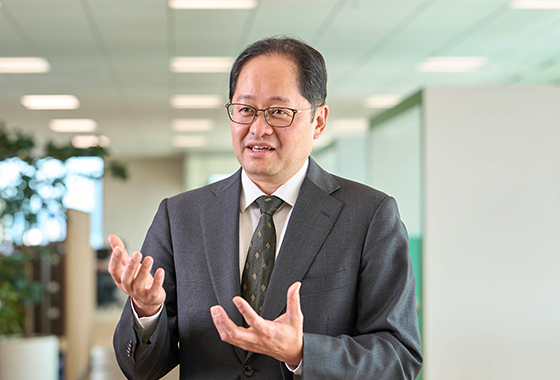
As uncertainty increases and constant changes are becoming the norm, such as the ongoing transformation and realignment of the business portfolio, I place the highest priority on linking management strategy with human resources strategy. In the Medium-term Management Plan 2029 announced in May 2026, we positioned “Cultivating capable individuals,” “Inclusion,” and “Strategic allocation of human resources” as our human resources strategy, and well-being and H&S as the foundation that supports this strategy. By combining initiatives under this human resources strategy with the use of DX/AI, we will enhance our execution capability of the management strategy. In organizational management, it is important to combine diverse talent and knowledge from different fields and practice appropriate allocation of human resources across the global group. To do this, I believe one of the important roles of the CHRO is to draw out the potential that lies in each employee, turn it into their individual strengths and confidence, and empower them to contribute to society in their own way. We will create an environment where the company’s diverse professionals can fully demonstrate their abilities, and build a strong organization in which each employee, as a creator of corporate value, can respond flexibly to changes and continue taking on challenges. To that end, I am determined to actively communicate management’s thinking to employees globally in a way that is clear and easy to grasp, help it take root, and encourage employees to change their behavior.
How will you approach recruiting, leveraging the talent pool, and company-wide optimal HR allocation to accelerate the execution of business strategies?
To effectively execute the business strategies set out in the Medium-term Management Plan, it is essential to secure and strengthen a group of professionals that has both sustainability and the ability to deliver immediate impact. We will therefore work to make our talent portfolio more diverse and effective. To achieve this, we hold the HR Strategy Meeting (HRSM), attended by the CEO, the CHRO, the COO of each business unit, and others, in order to advance our human resources strategy in an integrated manner with our management strategy. At the HRSM, management-level discussions are held on topics such as succession plans for key positions, the development and assignment of strategic talent, and the promotion of diverse talent, leading to the enhancement of our talent portfolio in response to changes in our business portfolio. By having management take the lead in discussing key HR-related themes, we will further accelerate strategic talent allocation on a global basis.
In addition, to enhance the effectiveness of the matters discussed at the HRSM, it is also important that all employees globally have a shared view of our talent philosophy, understand employees’ standards of conduct, and put them into practice. In 2020, we established “Mitsui Leadership in Action” as a global standard of conduct for employees, and in 2024, we formulated the “Global Talent Management Policy” for all employees worldwide, which set out the future direction that both employees and the company aim to achieve. Through these steps, we clearly articulated our approaches and policies on Mitsui’s human resources management. Our aim is to further accelerate initiatives by ensuring that all employees share a common understanding, rather than relying on tacit knowledge. In addition, to accelerate cross-organizational initiatives, which are one of the sources of our competitiveness, and to promote innovation by bringing together diverse knowledge, we introduced Bloom, a global talent management system, and are also working to combine the knowledge of diverse talent through appropriate placement and assignments. We will continue to focus on creating an environment where diverse employees can make the most of their abilities through inclusion measures, including working-style updates and the promotion of women’s career advancement, as well as revisions to HR systems in line with the times.
Please tell us about Bloom’s progress and the outcomes you expect going forward.
We introduced Bloom worldwide in 2024 and integrated and standardized HR information that had previously been scattered across overseas locations. We have established a foundation for visualizing the experience, skills, and strengths of each employee globally, and we are now at the stage of putting this data into practice to realize agile talent allocation in line with business strategies and each business phase, including new investment projects and projects in the middle game stage. To accelerate value creation by visualizing talent globally and allocating people in line with business strategies, we are working to understand in a timely manner the experience and skills of employees active in diverse fields and to expand opportunities for challenges across divisions and regions, regardless of hiring location or attributes. At the same time, by enabling employees to share information on their skills and experience with one another, Bloom helps them identify the career direction they want to pursue and recognize the skills they need for it, thereby supporting autonomous career development. By using Bloom data and AI, we will put into practice the concept of matching the best talent from around the world with the right positions and realize strategic global talent allocation linked to business strategies.
How will you visualize and verify the results of human capital investments and link them to the enhancement of corporate value?
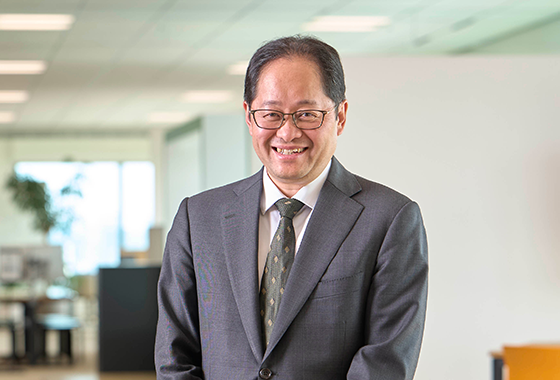
I believe the results of human capital investments cannot be measured by a single indicator alone and need to be analyzed comprehensively from both quantitative and qualitative perspectives.
On the quantitative side, in line with ISO 30414, the guideline for human capital, we disclose a wide range of data on initiatives in the HR area over a five-year period. Based on this data, we conduct analysis from various perspectives, such as changes over time and comparisons with other companies, and verify whether each HR initiative is leading to the results originally expected. In particular, we position employee engagement as an important indicator that shows, as the overall result of these initiatives, how deeply the company’s strategy, vision, and management direction have taken root among employees. Reflecting this view, changes in employee engagement from the previous fiscal year form part of the compensation formula for Directors, excluding external directors. It is also generally said that companies with a high level of employee engagement tend to perform well financially. As CHRO, I also place importance on engagement results, take the issues revealed by the indicators seriously, and am committed to making continuous improvements. Through this repeated process, we are working to refine our measures and initiatives.
On the qualitative side, while it is not easy to visualize outcomes in an easily comparable manner, we place emphasis on employees’ autonomous mindsets and initiative, as well as on enhancing organizational capabilities. For example, in navigating the middle game of business projects, it is important that each employee takes ownership of tackling challenging issues and that people with diverse values collaborate across organizational boundaries to arrive at optimal solutions. The source of our ability to drive business growth lies in the proactive actions of each employee and the organizational momentum that supports them. This is precisely the strength inherent in Mitsui’s corporate culture. We believe that the core of human capital lies in this kind of intangible value that cannot be fully captured by numbers, and that it serves as an important foundation supporting the sustainable enhancement of corporate value.
We will continue to steadily advance our initiatives by combining qualitative and quantitative perspectives and reviewing outcomes as appropriate.
HR Strategy Meeting
This meeting serves as a platform for in-depth discussions on key human capital topics, with the aim of supporting the organization’s sustainable growth by integrating business and talent strategies. Centered on succession planning for critical positions within our group, the meeting also involves reviewing and sharing the development status and policies for diverse talent, including female employees and regionally hired employees.
The discussions are attended by the CEO, CHRO, and the General Managers of Human Resources & General Affairs Divisions I and II. They engage in direct dialogue with the Chief Operating Officers of each business unit, the General Managers of Corporate Staff Divisions, and CHROs of regional business units. Taking into account changes in the business environment and business portfolio, we discuss succession plans for key positions and roles along with the development of diverse talent, and work to link management strategy and human resources strategy. This enables continuous monitoring of the global and diverse successor talent pool, and facilitates strategic matching of the right people to the right positions to maximize organizational performance.
This also plays an important role from the perspective of business continuity planning (BCP) in preparation for unforeseen events, and is an element that supports continuity in organizational management and stable business operations.